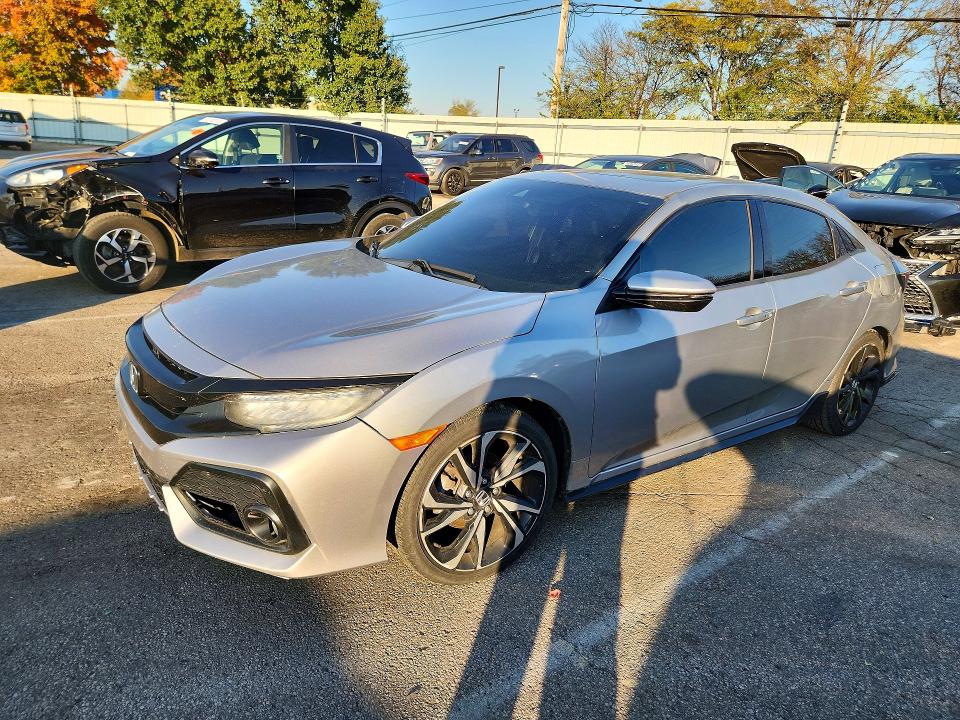
2017 Honda Civic Flood Salvage: $14K Car, $100 Bid, $0 Future
Salvage title means you can't finance it, insure it properly, or sell it without confessing. The flood is just the opening act.
How is the Shame Score calculated?
The Shame Score (1–10) combines five signals: damage-type severity, title-condition risk, the gap between ACV (Actual Cash Value — the car's pre-damage market price) and AI max bid, listing red flags (run/drive status, secondary damage), and misleading-listing signals from AI photo analysis. A score of 8+ means the model found no financially defensible reason to bid. ACV is pulled from auction listing data; repair costs reference industry body-shop benchmarks. All figures are directional estimates, not binding quotes. Repair costs reference CCC Intelligent Solutions benchmarks and regional body-shop averages.
Would you bid?
Vehicle
2017 HONDA CIVIC
Title
salvage
Damage
WATER/FLOOD
State
Ohio
Mileage
100-150k
Runs/drives
Yes
Approx ACV
~$15,000
AI max bid
$0
ACV from auction listing data · Repair costs via CCC benchmarks + body-shop averages
In plain numbers: Someone is bidding ~$13,500+ on this vehicle. AI analysis says it's worth at most $0 as a project. That's a $15,000gap. Here's why.
A 2017 Civic Sport Touring is genuinely one of the better compact builds Honda put out that decade — turbocharged 1.5L, Honda Sensing suite, the full leather-and-tech package that made it punch above its class. At $100 current bid on a car with a $14,725 ACV (Actual Cash Value — what it was worth before the water got in), the math looks like a gift. It has a key. It runs and drives. Someone is going to see this and feel clever.
The listing says water/flood damage with no secondary damage listed. That blank space is not reassuring — it means nobody went looking, not that nothing is there. A Civic that runs and drives post-flood is not a Civic that survived the flood. It's a Civic whose engine happened to start. The ECU (engine control unit — the car's central brain), the ABS module, the transmission solenoids, the airbag control module, the lane-keep and collision-warning sensors in that Honda Sensing suite — every one of those lives in a sealed box that is not actually sealed against sustained water intrusion. They work until they don't, and they don't on a schedule nobody can predict.
Here's what the repair math looks like when the schedule arrives. Mold remediation on a flooded cabin runs $1,500–$2,500, and that's before you pull the seats and find the padding underneath has been composting since whatever storm did this. The Honda Sensing radar unit alone is $1,800–$2,400 to replace. One failed ABS module is $900 parts and labor. A CVT (continuously variable transmission — the belt-driven unit Honda used in this generation that is famously intolerant of contamination) service and inspection after flood exposure is $600 minimum and replacement is $3,500–$4,500 if the water got in, which it did. Frame inspection, rust treatment on the subframe and floor pans, wiring harness replacement if corrosion has started — you're at ECU $1,200 + CVT $4,000 + mold $2,000 + sensors $2,400 + wiring $1,800 = $11,400 before you've replaced a single normal wear item on a 141,000-mile car that still needs brakes, tires, and whatever the previous 141,182 miles deferred.
The salvage title (legally declared a total loss by an insurance company) is the part that follows you forever. No mainstream lender touches it. Progressive, State Farm, GEICO — they'll write liability only, meaning the car is one fender-bender away from being your problem entirely. When you try to sell it, you disclose the title, the buyer's eyes go flat, and you take whatever they'll give you. Keisha in Memphis is going to bid $2,400 on this thinking she's buying a commuter and spend the next two years explaining to every mechanic why the dash lights up like a Christmas tree every time it rains.
“The carpets are drier than the title history.”
What to watch for: WATER/FLOOD
- •Pull the driver's seat and press your palm flat into the carpet padding underneath. Not damp — wet. Six months after a flood, that padding holds moisture like a sponge and you won't smell it until summer turns the cabin into a petri dish.
- •Open the fuse box under the hood and look at the relay terminals. Green or white corrosion on the metal contacts means water reached the electrical system's spine. That corrosion is still traveling.
- •With the car running, turn on every Honda Sensing feature — adaptive cruise, lane keep, collision warning — and drive it above 25 mph. Flood-damaged sensor modules often pass a stationary test and fail the moment they're asked to actually work.
- •Remove the cabin air filter housing and shine a flashlight into the HVAC blower cavity. Mud, silt, or debris in there means water entered the ventilation system, which means mold spores are now distributed through every vent in the car every time you run the heat.
- •Check the VIN plate on the dashboard and the VIN stamp on the door jamb. If either shows any sign of water staining or the surrounding metal has surface rust, the water line was at or above the dash — and the entire wiring harness behind the instrument cluster is compromised.
Tomorrow’s lot. Before the auction. Free.
One lot. AI verdict. Max bid. The numbers that matter — before you bid.
Not bidding? Same email — one lot, one roast, every morning. Join readers who watch so they never bid blind.
Not ready? Browse all entries →TL;DR — copy & share
2017 HONDA CIVIC / WATER/FLOOD / Ohio / ACV ~$15,000 Shame Score: 8.2/10 | AI Max Bid: $0 The carpets are drier than the title history. vetmyride.com/hall-of-shame/2017-honda-civic-flood-salvage-k-car-bid-future-74179286
Previous entry
2014 MAZDA CX-5 · Shame 8.2
“The roof is the cheapest thing wrong with this car.”
Lot identifying info (lot number, VIN, seller, exact sale date) scrubbed. AI commentary is opinion based on publicly listed damage + auction signals. Always inspect in person before bidding.
AI-generated opinion based on publicly listed auction data. Not a factual vehicle assessment. Actual vehicle condition may differ from listing description. All figures are directional estimates, not binding quotes. VetMyRide is not affiliated with, endorsed by, or sponsored by any auction platform. Not a substitute for professional inspection.