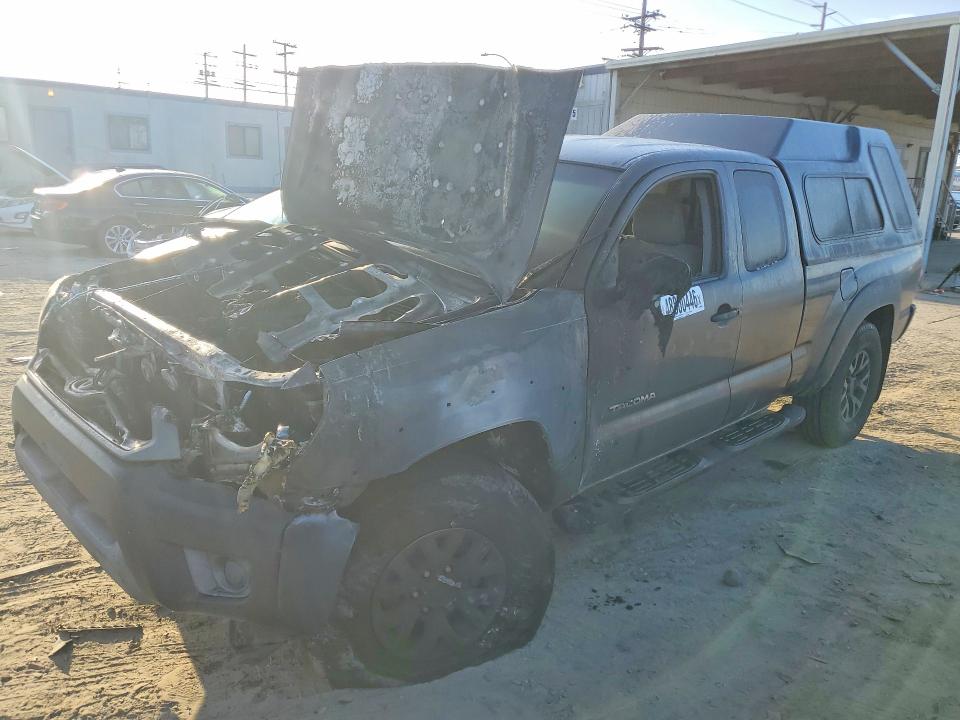
2013 Toyota Tacoma PreRunner V6: Salvage Title, Engine Fire, Zero Miles Known
Salvage title on a Tacoma means the truck everyone trusts now has a past no CarFax survives.
How is the Shame Score calculated?
The Shame Score (1–10) combines five signals: damage-type severity, title-condition risk, the gap between ACV (Actual Cash Value — the car's pre-damage market price) and AI max bid, listing red flags (run/drive status, secondary damage), and misleading-listing signals from AI photo analysis. A score of 8+ means the model found no financially defensible reason to bid. ACV is pulled from auction listing data; repair costs reference industry body-shop benchmarks. All figures are directional estimates, not binding quotes. Repair costs reference CCC Intelligent Solutions benchmarks and regional body-shop averages.
Would you bid?
Vehicle
2013 TOYOTA TACOMA
Title
salvage
Damage
BURN - ENGINE
State
California
Mileage
—
Runs/drives
—
Approx ACV
~$15,000
AI max bid
$0
ACV from auction listing data · Repair costs via CCC benchmarks + body-shop averages
In plain numbers: Someone is bidding ~$13,500+ on this vehicle. AI analysis says it's worth at most $0 as a project. That's a $15,000gap. Here's why.
A 2013 Tacoma PreRunner V6 at zero dollars bid. The truck that holds its value better than almost anything on the road, the one your dad told you to buy, the one with 4.0 liters of legendary reliability and a bed that'll outlast your mortgage. The ACV (Actual Cash Value — what it was worth before the fire) sits at $15,175, which for a Tacoma is almost modest. You're looking at a truck that, clean, would sell itself. The listing knows this. The listing is counting on you knowing this.
The damage category is BURN — ENGINE. Not BURN — INTERIOR, where you're replacing carpet and calling it a day. Engine. The fire started at or near the 4.0-liter V6 that made this truck worth $15,000 in the first place. Engine fires don't stay polite. Heat travels up wiring harnesses, through firewall grommets, into the cab. The listing shows no secondary damage, which sounds reassuring until you realize that means nobody checked, not that nothing burned. Mileage is unknown. The odometer either melted, failed, or was never reported. Pick your favorite.
A replacement 4.0-liter V6 for a 2013 Tacoma runs $3,500 to $5,500 for a used unit with unknown history, or $7,000 to $9,000 for a remanufactured engine with a warranty worth having. Add $1,200 to $1,800 in labor. The wiring harness — and on a fire this deep, you are replacing the wiring harness — is $800 to $2,400 depending on how far the heat traveled. If the firewall insulation burned, add another $600. If the ECU (Engine Control Unit — the truck's main computer, mounted close to the engine bay) cooked, that's $900 to $1,400 for a Tacoma-specific unit and a reflash. You're at $3,500 engine + $1,500 labor + $1,600 harness + $1,400 ECU = $8,000 before you've touched anything cosmetic, before you've dealt with the salvage title (legally declared a total loss by an insurance company), and before you've found out what else the fire touched that the photos didn't show.
Salvage Tacomas sell. The market for them is real. But a clean-title 2013 Tacoma PreRunner V6 in average condition retails between $18,000 and $22,000. A salvage-title version of the same truck, fully repaired and inspected, tops out around $13,000 to $14,000 — below the ACV on this one before you've spent a dollar. Bethany in Knoxville is going to see the Tacoma badge, see the zero-dollar bid, and convince herself she found the one. Every dollar she bids is a dollar she's paying for the privilege of learning what engine fires actually cost.
“Toyota built it to last 300,000 miles. The engine fire had other plans.”
What to watch for: BURN - ENGINE
- •Stand at the open hood and look at every wiring harness you can see. Fire-damaged wiring has melted insulation that cracks and flakes when you bend it — run your fingers along the main harness from the fuse box toward the firewall. If the plastic crumbles, the whole harness is compromised, not just the section you can see.
- •Find the firewall — the metal wall between the engine bay and the cab — and look for bubbled paint, warped rubber grommets, or any discoloration on the cab side. If the firewall insulation burned through, heat entered the cab and every wire that passes through those grommets is suspect.
- •Pull the fuse box cover in the engine bay and look at the fuses and relays. Heat-damaged fuse boxes show melted plastic around the relay sockets and discolored or warped fuse holders. A burned fuse box on a Tacoma is a $400-$900 part before labor.
- •Check the ECU location — on the 2013 Tacoma 4.0 V6, it sits near the passenger-side firewall. Look for heat discoloration on the ECU housing or on the connector pins. A cooked ECU will not throw a code; it will simply stop working, or work wrong, or work fine for three weeks and then strand you.
Tomorrow’s lot. Before the auction. Free.
One lot. AI verdict. Max bid. The numbers that matter — before you bid.
Not bidding? Same email — one lot, one roast, every morning. Join readers who watch so they never bid blind.
Not ready? Browse all entries →TL;DR — copy & share
2013 TOYOTA TACOMA / BURN - ENGINE / California / ACV ~$15,000 Shame Score: 8.2/10 | AI Max Bid: $0 Toyota built it to last 300,000 miles. The engine fire had other plans. vetmyride.com/hall-of-shame/2013-toyota-tacoma-prerunner-v6-salvage-title-engine-fire-zero-miles-known-48800446
Previous entry
2016 HYUNDAI SANTA FE · Shame 8.7
“The mileage is unknown because the odometer had other things to worry about.”
Lot identifying info (lot number, VIN, seller, exact sale date) scrubbed. AI commentary is opinion based on publicly listed damage + auction signals. Always inspect in person before bidding.
AI-generated opinion based on publicly listed auction data. Not a factual vehicle assessment. Actual vehicle condition may differ from listing description. All figures are directional estimates, not binding quotes. VetMyRide is not affiliated with, endorsed by, or sponsored by any auction platform. Not a substitute for professional inspection.