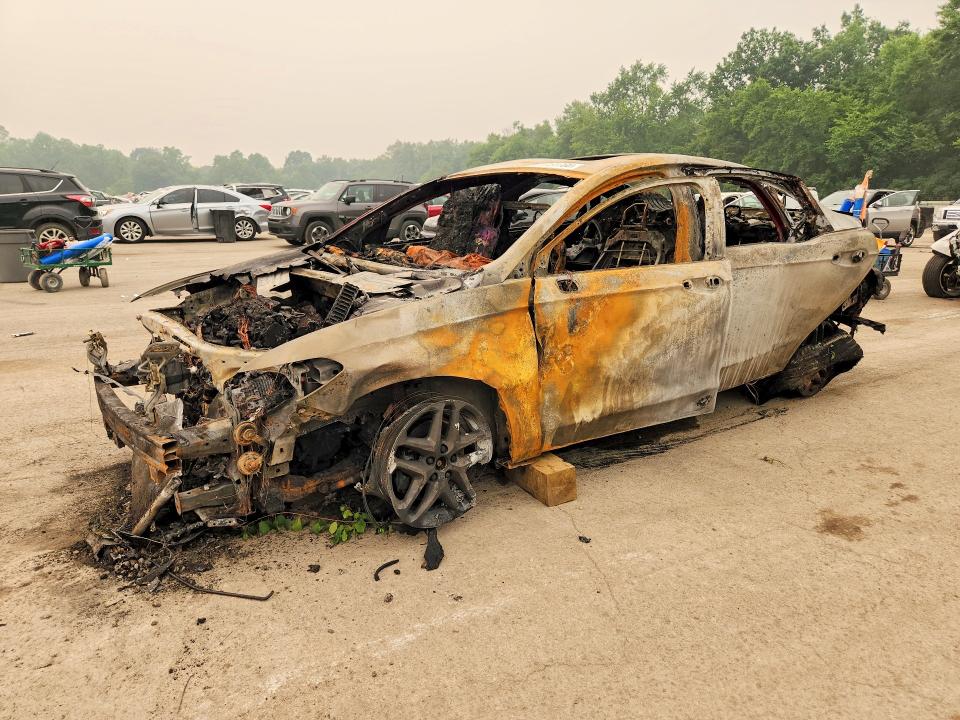
2013 Ford Fusion SE: Salvage Title, Fire Damage, Zero Answers
Fire warps frames, melts wiring harnesses, and voids every warranty. The unknown here isn't a mystery — it's a warning.
How is the Shame Score calculated?
The Shame Score (1–10) combines five signals: damage-type severity, title-condition risk, the gap between ACV (Actual Cash Value — the car's pre-damage market price) and AI max bid, listing red flags (run/drive status, secondary damage), and misleading-listing signals from AI photo analysis. A score of 8+ means the model found no financially defensible reason to bid. ACV is pulled from auction listing data; repair costs reference industry body-shop benchmarks. All figures are directional estimates, not binding quotes. Repair costs reference CCC Intelligent Solutions benchmarks and regional body-shop averages.
Would you bid?
Vehicle
2013 FORD FUSION
Title
salvage
Damage
BURN
State
Pennsylvania
Mileage
—
Runs/drives
—
Approx ACV
~$7,000
AI max bid
$0
ACV from auction listing data · Repair costs via CCC benchmarks + body-shop averages
In plain numbers: Someone is bidding ~$6,300+ on this vehicle. AI analysis says it's worth at most $0 as a project. That's a $7,000gap. Here's why.
A 2013 Ford Fusion SE is not a bad car. Mid-size, decent fuel economy, the kind of sedan that spent a decade being quietly reliable in suburban driveways. At $0 current bid against a $6,700 ACV (Actual Cash Value — what the car was worth before the fire), the math looks like it has room. Someone's going to see that spread and start calculating profit margins on a napkin.
The listing says burn damage. It doesn't say where. Doesn't say how bad. Doesn't say whether the fire started in the engine bay, the cabin, the trunk, or the fuel system. Run/drive is unknown. Keys are unknown. Mileage is unknown. That's not an incomplete listing — that's a car that couldn't tell you its own story even if it wanted to. Fire damage without a point of origin is a choose-your-own-adventure where every ending costs money.
Here's what fire does to a car that the listing photo won't show you: it travels. A cabin fire melts the wiring harness, and a Fusion harness replacement runs $1,800 to $3,400 in parts alone before labor. It destroys the ECU (Engine Control Unit — the brain of the car), add $400 to $900. It warps door frames and roof pillars, which means gaps, leaks, and a car that will never seal correctly again. If the fire touched the firewall, you're looking at structural repair that a body shop will quote and then quietly suggest you don't do. Mold remediation if water was used to suppress it: $800 to $2,000. And if the fuel system was involved — fuel line replacement, tank inspection, injector cleaning — that's another $1,200 to $2,500 before you've addressed a single cosmetic problem. Fire damage $2,600 + wiring harness $2,600 + ECU $700 + structural assessment $300 + mold $1,400 = $7,600 before you know whether the engine survived. That's already more than the ACV on a car you still can't start.
Someone is going to bid on this because the number starts at zero and the optimism is free. They'll win it, transport it, pull back the melted door panel, and spend the next four months learning what insurance adjusters already knew when they wrote this one off. Keisha in Memphis is going to bid on this and find out that 'burn' is not a damage category — it's a eulogy. Walk.
“The only thing hotter than this Fusion's interior was whoever decided to list it with no keys and no answers.”
What to watch for: BURN
- •Stand at the driver's door and look across the roofline. Fire warps pillars and roof rails in ways paint can hide — you're looking for ripples, gaps at the door seams, or a roof that doesn't sit flush. Any of those means structural damage that a frame machine can't fix.
- •Pull back whatever's left of the carpet and find the wiring harness running along the floor and up the firewall. Melted insulation looks like black crumble or hardened plastic. If you see it anywhere, assume the entire harness is compromised — you can't splice your way out of fire damage.
- •Check the fuse box, both under the hood and under the dash. Fire-damaged fuse boxes show burn marks, melted plastic, and fused (stuck closed) breakers. A car with a compromised fuse box is an electrical fire waiting to happen again.
- •Look at the firewall from inside the engine bay with a flashlight. Bubbled paint, warped metal, or melted rubber grommets where wiring passes through means the fire crossed from cabin to engine bay or vice versa — the worst possible scenario for repair cost.
- •If the car was suppressed with water or foam, press your palm flat on the carpet padding in the rear footwells. Damp padding months after a fire means the floor pan is trapping moisture and rusting from underneath. You won't see it until the floor falls out.
Tomorrow’s lot. Before the auction. Free.
One lot. AI verdict. Max bid. The numbers that matter — before you bid.
Not bidding? Same email — one lot, one roast, every morning. Join readers who watch so they never bid blind.
Not ready? Browse all entries →TL;DR — copy & share
2013 FORD FUSION / BURN / Pennsylvania / ACV ~$7,000 Shame Score: 9.1/10 | AI Max Bid: $0 The only thing hotter than this Fusion's interior was whoever decided to list it with no keys and no answers. vetmyride.com/hall-of-shame/2013-ford-fusion-se-salvage-title-fire-damage-zero-answers-61751786
Previous entry
2016 MITSUBISHI OUTLANDER · Shame 7.8
“The insurance company said no. The auction says your turn.”
Lot identifying info (lot number, VIN, seller, exact sale date) scrubbed. AI commentary is opinion based on publicly listed damage + auction signals. Always inspect in person before bidding.
AI-generated opinion based on publicly listed auction data. Not a factual vehicle assessment. Actual vehicle condition may differ from listing description. All figures are directional estimates, not binding quotes. VetMyRide is not affiliated with, endorsed by, or sponsored by any auction platform. Not a substitute for professional inspection.