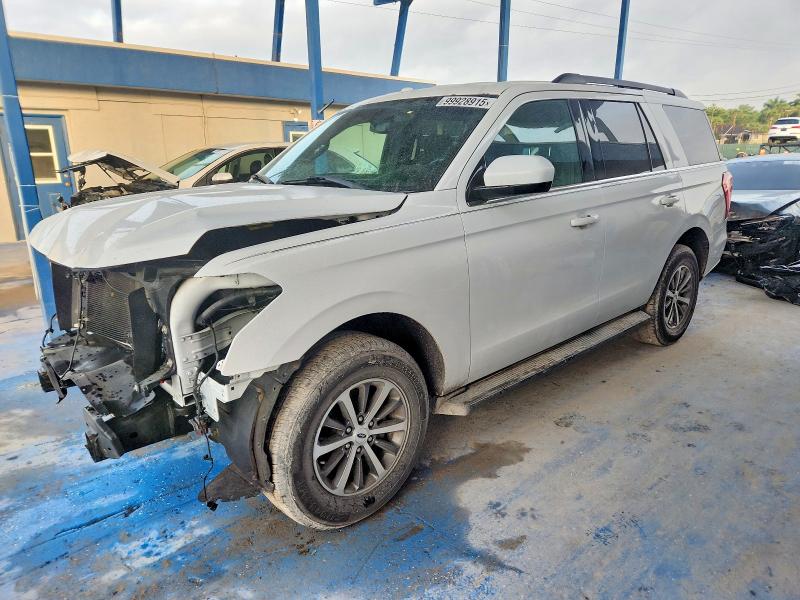
2018 Ford Expedition XLT Salvage: $6,300 Buy-Now on an $18K Wreck
You can't finance a salvage title. You can't insure it properly. And the frame under that crumpled nose tells the whole story.
How is the Shame Score calculated?
The Shame Score (1–10) combines five signals: damage-type severity, title-condition risk, the gap between ACV (Actual Cash Value — the car's pre-damage market price) and AI max bid, listing red flags (run/drive status, secondary damage), and misleading-listing signals from AI photo analysis. A score of 8+ means the model found no financially defensible reason to bid. ACV is pulled from auction listing data; repair costs reference industry body-shop benchmarks. All figures are directional estimates, not binding quotes. Repair costs reference CCC Intelligent Solutions benchmarks and regional body-shop averages.
Would you bid?
Vehicle
2018 FORD EXPEDITION
Title
salvage
Damage
FRONT END
State
Florida
Mileage
50-100k
Runs/drives
Yes
Approx ACV
~$18,000
AI max bid
$0
ACV from auction listing data · Repair costs via CCC benchmarks + body-shop averages
In plain numbers: Someone is bidding ~$16,200+ on this vehicle. AI analysis says it's worth at most $0 as a project. That's a $18,000gap. Here's why.
A 2018 Ford Expedition XLT at 64,991 miles with a buy-now of $6,300 against a Copart ACV (Actual Cash Value — what it was worth before the wreck) of $18,425. That's a $12,000 gap staring at you like a parking spot that's too good to be true. Three-row seating, tow package almost certainly on this trim, EcoBoost V6 that actually moves this thing — on paper, for six grand, you're buying a family hauler at a price that makes you feel smart. The listing says it runs and drives. It has a key. For thirty seconds, this looks like the one.
The primary damage is front end. On a full-size body-on-frame SUV, that phrase is doing a lot of quiet work. The Expedition's front end houses the EcoBoost 3.5L twin-turbo engine, the intercoolers, the radiator, the transmission cooler lines, and on this trim almost certainly Ford's electric power steering rack. A front-end hit hard enough to write off an $18,000 vehicle didn't stop at the bumper cover. The question isn't whether something behind the grille is bent. The question is how far back the damage travels before it stops.
Frame straightening on a body-on-frame this size runs $2,500 to $4,500 depending on severity — and that's before they find what they find. Radiator and cooling system $800. Transmission cooler lines if compromised $400. Power steering rack $1,100 parts and labor. Hood, fenders, bumper assembly, and whatever the impact pushed into the engine bay: figure $3,200 in sheetmetal and clips alone. If either turbocharger took a hit from debris or a pressure spike at impact, add $2,800 per side. Conservative total: $4,200 frame work + $2,500 cooling and steering + $3,200 sheetmetal = $9,900 before you've looked at the turbos. Optimistic total. And salvage title (legally declared a total loss by an insurance company) means no traditional financing, stripped resale value, and an insurance conversation you will lose every single time.
Someone is going to click buy-now on this because $6,300 for an Expedition feels like stealing. Keisha in Marietta is going to buy it, spend $11,000 fixing it, and end up with a $17,300 salvage-titled Expedition she can't sell for $10,000. The ACV was $18,425 before the wreck. After a salvage brand, the ceiling on resale is roughly 60% of clean ACV — call it $11,000 on a perfect day. This is not a deal. This is a $6,300 entry fee to a much more expensive problem.
“The buy-now is $6,300. The frame rails aren't.”
What to watch for: FRONT END
- •Get under the front and sight down both frame rails from the bumper toward the firewall. They should be straight and parallel. Any bow, crinkle, or shiny spot where the paint has stretched means the frame absorbed the hit — not just the sheetmetal.
- •Pull the hood and look at the radiator support welds. Factory welds are uniform and slightly rough. If you see smooth, shiny, or layered weld beads anywhere on the support, it's been repaired — and the shop didn't disclose how far back the damage actually went.
- •Start the engine cold and watch the coolant reservoir for the first five minutes. Bubbles rising into the reservoir with the cap off can mean a cracked intercooler or compromised cooling line from impact — problems that don't throw codes until the engine is under load on a highway.
- •Check both turbo inlet pipes by hand for cracks or soft spots. On the 3.5L EcoBoost, the charge pipes run right through the front impact zone. A hairline crack will idle fine and fail at 70 mph under boost.
- •Ask for the insurance total-loss paperwork or the CCC valuation report. If the insurer's repair estimate is in there, you'll see exactly what they found — and what they stopped counting when the number passed the car's value.
Tomorrow’s lot. Before the auction. Free.
One lot. AI verdict. Max bid. The numbers that matter — before you bid.
Not bidding? Same email — one lot, one roast, every morning. Join readers who watch so they never bid blind.
Not ready? Browse all entries →TL;DR — copy & share
2018 FORD EXPEDITION / FRONT END / Florida / ACV ~$18,000 Shame Score: 7.8/10 | AI Max Bid: $0 The buy-now is $6,300. The frame rails aren't. vetmyride.com/hall-of-shame/2018-ford-expedition-xlt-salvage-buy-now-on-an-k-wreck
Previous entry
2024 FORD TRANSIT · Shame 8.2
“Forty thousand dollars of van and the title is worth less than the fuel in the tank.”
Lot identifying info (lot number, VIN, seller, exact sale date) scrubbed. AI commentary is opinion based on publicly listed damage + auction signals. Always inspect in person before bidding.
AI-generated opinion based on publicly listed auction data. Not a factual vehicle assessment. Actual vehicle condition may differ from listing description. All figures are directional estimates, not binding quotes. VetMyRide is not affiliated with, endorsed by, or sponsored by any auction platform. Not a substitute for professional inspection.