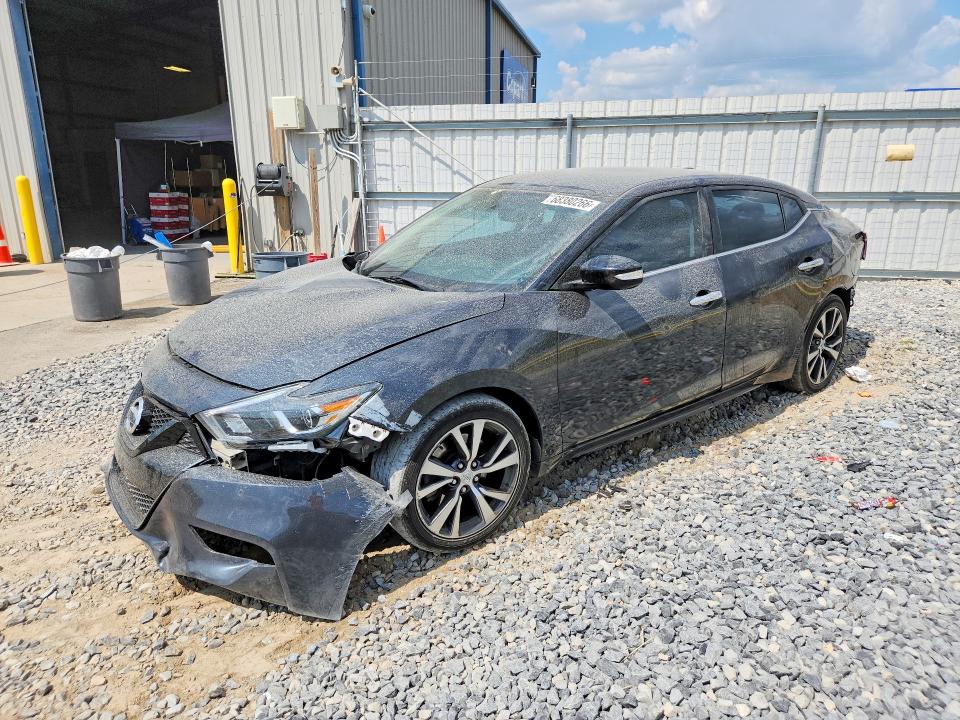
2017 Nissan Maxima Salvage: 'All Over' Damage at 97K Miles
They couldn't name the damage because naming it would require choosing where to start.
How is the Shame Score calculated?
The Shame Score (1–10) combines five signals: damage-type severity, title-condition risk, the gap between ACV (Actual Cash Value — the car's pre-damage market price) and AI max bid, listing red flags (run/drive status, secondary damage), and misleading-listing signals from AI photo analysis. A score of 8+ means the model found no financially defensible reason to bid. ACV is pulled from auction listing data; repair costs reference industry body-shop benchmarks. All figures are directional estimates, not binding quotes. Repair costs reference CCC Intelligent Solutions benchmarks and regional body-shop averages.
Would you bid?
Vehicle
2017 NISSAN MAXIMA
Title
salvage
Damage
ALL OVER
State
Tennessee
Mileage
50-100k
Runs/drives
Yes
Approx ACV
~$10,000
AI max bid
$0
ACV from auction listing data · Repair costs via CCC benchmarks + body-shop averages
In plain numbers: Someone is bidding ~$9,000+ on this vehicle. AI analysis says it's worth at most $0 as a project. That's a $10,000gap. Here's why.
A 2017 Nissan Maxima 3.5 SV with a working engine, a key, and a $0 current bid. The Maxima SV is the sweet spot of the lineup — V6, CVT, sport-tuned everything, the sedan Nissan built when they still cared about sedans. At $10,075 ACV (Actual Cash Value — what the car was worth before whatever happened to it), you're looking at a car that should retail somewhere north of $14,000 clean. The math looks interesting. The math is a trap.
The primary damage field reads: ALL OVER. Not 'front end.' Not 'rear impact.' Not 'rollover.' All over. That is the auction equivalent of a doctor walking into the waiting room, sitting down slowly, and saying 'so, it's a lot of things.' The listing doesn't elaborate because elaborating would require a category system, and this car has exceeded the category system. Secondary damage is blank — not because there isn't any, but because whoever filled out the form ran out of patience.
The CVT (continuously variable transmission — a belt-driven gearbox that Nissan has been quietly destroying since 2012) in this generation Maxima is already on borrowed time at 97,581 miles. Nissan's own extended warranty on CVT failures cut off at 84,000 miles. You are 13,581 miles past the point where Nissan would help you. A CVT replacement on a 2017 Maxima runs $3,500 to $4,800 in parts and labor. That's before you've addressed whatever 'all over' means structurally. Frame inspection $400 + alignment $250 + CVT replacement $4,200 + suspension components $1,800 + unspecified 'all over' body and mechanical damage $3,000 conservative = $9,650 in repairs on a $10,075 ACV car. And $3,000 is not a serious estimate for 'all over' damage. It's a wish.
Someone is going to bid on this because the V6 runs and the key turns and $0 feels like an invitation. Destiny in Shreveport is going to win it for $2,400, drive it onto a trailer feeling like a genius, and spend the next four months discovering new meanings of the phrase 'all over.' The salvage title (legally declared a total loss by an insurance company) alone kills resale, kills financing, and in several states complicates registration. You cannot fix 'all over.' You can only keep paying for it.
“'All over' is not a damage category. It's a crime scene summary.”
What to watch for: ALL OVER
- •Get under the car and look at every subframe mounting point. 'All over' damage on a unibody like the Maxima means energy traveled somewhere — find where the metal is kinked, creased, or no longer parallel. Bring a flashlight and a straight edge. If the subframe mounting points don't line up, the car is a parts donor.
- •Pull the carpet and padding in all four footwells and the trunk. Press down hard. If moisture comes up, or if the padding is stiff and discolored, the car has seen water at some point in its 'all over' history. Mold remediation on a sedan runs $1,500 to $3,000 and it never fully works.
- •Start the engine cold and listen for the first 90 seconds. A CVT on its way out will whine or shudder under light acceleration, especially when the fluid is cold. If it hesitates pulling out of a parking spot, budget $4,200 and do not negotiate yourself out of that number.
- •Check all four corners for mismatched panel gaps around the doors and fenders. On a car with 'all over' damage, the body may have been pulled enough to open and close doors — but gaps wider than a finger's width on any seam mean the structure was bent and reset, not repaired.
- •Run the VIN through every database you can find — NMVTIS, CARFAX, AutoCheck. 'All over' damage with a salvage title and no secondary damage listed is the profile of a car that may have changed hands across state lines before the total loss was fully reported. Know what state the title originated in.
Tomorrow’s lot. Before the auction. Free.
One lot. AI verdict. Max bid. The numbers that matter — before you bid.
Not bidding? Same email — one lot, one roast, every morning. Join readers who watch so they never bid blind.
Not ready? Browse all entries →TL;DR — copy & share
2017 NISSAN MAXIMA / ALL OVER / Tennessee / ACV ~$10,000 Shame Score: 9.2/10 | AI Max Bid: $0 'All over' is not a damage category. It's a crime scene summary. vetmyride.com/hall-of-shame/2017-nissan-maxima-salvage-all-over-damage-at-68380266
Previous entry
2019 CHEVROLET SILVERADO · Shame 9.2
“The damage location is 'all over' — which is also where your money goes.”
Lot identifying info (lot number, VIN, seller, exact sale date) scrubbed. AI commentary is opinion based on publicly listed damage + auction signals. Always inspect in person before bidding.
AI-generated opinion based on publicly listed auction data. Not a factual vehicle assessment. Actual vehicle condition may differ from listing description. All figures are directional estimates, not binding quotes. VetMyRide is not affiliated with, endorsed by, or sponsored by any auction platform. Not a substitute for professional inspection.