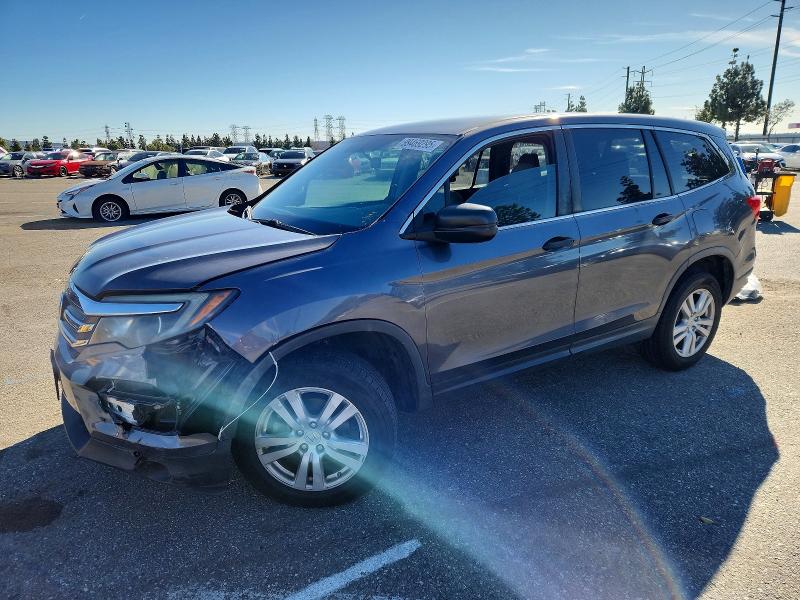
2016 Honda Pilot LX Salvage Front End: $5,300 Toward a $11K Mistake
You can't insure it full coverage. You can't trade it in. You can finance the repairs but not the Pilot.
How is the Shame Score calculated?
The Shame Score (1–10) combines five signals: damage-type severity, title-condition risk, the gap between ACV (Actual Cash Value — the car's pre-damage market price) and AI max bid, listing red flags (run/drive status, secondary damage), and misleading-listing signals from AI photo analysis. A score of 8+ means the model found no financially defensible reason to bid. ACV is pulled from auction listing data; repair costs reference industry body-shop benchmarks. All figures are directional estimates, not binding quotes. Repair costs reference CCC Intelligent Solutions benchmarks and regional body-shop averages.
Would you bid?
Vehicle
2016 HONDA PILOT
Title
salvage
Damage
FRONT END
State
California
Mileage
50-100k
Runs/drives
Yes
Approx ACV
~$11,000
AI max bid
$0
ACV from auction listing data · Repair costs via CCC benchmarks + body-shop averages
In plain numbers: Someone is bidding ~$9,900+ on this vehicle. AI analysis says it's worth at most $0 as a project. That's a $11,000gap. Here's why.
Ninety-one thousand miles on a 2016 Pilot LX and it's still running — that's the Honda tax at work, and for a second you can see it. Seven seats, AWD, the kind of SUV that soccer dads and road-trip families buy with zero drama. Current bid sitting at $5,300 on an $11,250 ACV (Actual Cash Value — what the car was worth before the wreck) means you're theoretically buying at a 53-cent discount. The thing drives. It has a key. Someone's going to look at that spread and feel very smart.
Front-end damage on a Pilot is not a bumper cover and a headlight. The 2016 Pilot runs a unibody platform, which means the front crash structure — the rails, the radiator support, the strut towers — is load-bearing in a way that a body-on-frame truck is not. The listing says 'front end.' It does not say how far back. It does not say whether the subframe took the hit. It does not say what happened to the steering rack, the condenser, or the transmission cooler lines that run through the front fascia. 'Runs and drives' at an auction lane means it moved under its own power. It does not mean it tracks straight. It does not mean the front suspension geometry survived.
Front clip replacement on a 2016 Pilot runs $1,800–$2,400 in parts alone. Frame rail repair or replacement, if the unibody absorbed impact, adds $2,500–$4,500 depending on severity. Radiator and condenser: $600–$900. Steering rack if it's bent or leaking: $800–$1,200. Airbag module reset plus any deployed bags: $1,200–$2,000. Alignment after all of it: $150. That's $6,850–$11,250 in a best-case scenario where nothing surprises you — and front-end unibody work always surprises you. $5,300 bid + $9,000 in conservative repairs = $14,300 for a salvage-titled Pilot with a clean-title private-party value of $11,250. You have paid $3,050 for the privilege of owning a car no bank will finance and no CarMax will touch.
The salvage title (legally declared a total loss by an insurance company) is permanent. It transfers with the car in every state. Resale value drops 20–40% against a clean-title equivalent — on an $11,250 car, that's $2,250–$4,500 gone before you negotiate. Full-coverage insurance will be declined by most carriers or priced into absurdity. You will own this car until it dies, and when it does, the salvage title is still on the death certificate. Destiny in Naperville is going to outbid three other people on this and spend the next four months explaining to her insurance agent why the front end looks like that.
“The Pilot survived the crash. Your resale value didn't.”
What to watch for: FRONT END
- •Stand ten feet in front of the car and crouch to hood level. Sight down both front fenders toward the windshield. If one side sits higher or the gaps are uneven, the unibody rails absorbed the hit and were not fully straightened — or were never straightened at all.
- •Open the hood and look at the radiator support welds where they meet the front frame rails. Fresh undercoating, new paint, or visible weld seams that don't match the factory finish mean the structure was repaired. Ask yourself how it was repaired and by whom.
- •With the car running, turn the wheel lock to lock and listen for grinding, clicking, or resistance. A damaged steering rack or bent tie rod will telegraph immediately. If you can't test-drive it, that sound is the $1,000 you didn't hear.
- •Check both front CV axle boots for tears or grease flung on the inside of the wheel well. Front impact can torque the axles enough to split a boot without destroying the joint immediately — the joint fails six months later.
- •Pull up the driver's floor mat and press your palm flat on the carpet. Any stiffness, wrinkling, or resistance to pressing flat means the floor pan underneath has deformed — a sign the crash energy traveled past the front clip and into the passenger cell.
Tomorrow’s lot. Before the auction. Free.
One lot. AI verdict. Max bid. The numbers that matter — before you bid.
Not bidding? Same email — one lot, one roast, every morning. Join readers who watch so they never bid blind.
Not ready? Browse all entries →TL;DR — copy & share
2016 HONDA PILOT / FRONT END / California / ACV ~$11,000 Shame Score: 7.5/10 | AI Max Bid: $0 The Pilot survived the crash. Your resale value didn't. vetmyride.com/hall-of-shame/2016-honda-pilot-lx-salvage-front-end-toward-a-k-mistake
Previous entry
2021 TESLA MODEL 3 · Shame 9.2
“They removed the key so you can't find out what the car already knows.”
Lot identifying info (lot number, VIN, seller, exact sale date) scrubbed. AI commentary is opinion based on publicly listed damage + auction signals. Always inspect in person before bidding.
AI-generated opinion based on publicly listed auction data. Not a factual vehicle assessment. Actual vehicle condition may differ from listing description. All figures are directional estimates, not binding quotes. VetMyRide is not affiliated with, endorsed by, or sponsored by any auction platform. Not a substitute for professional inspection.