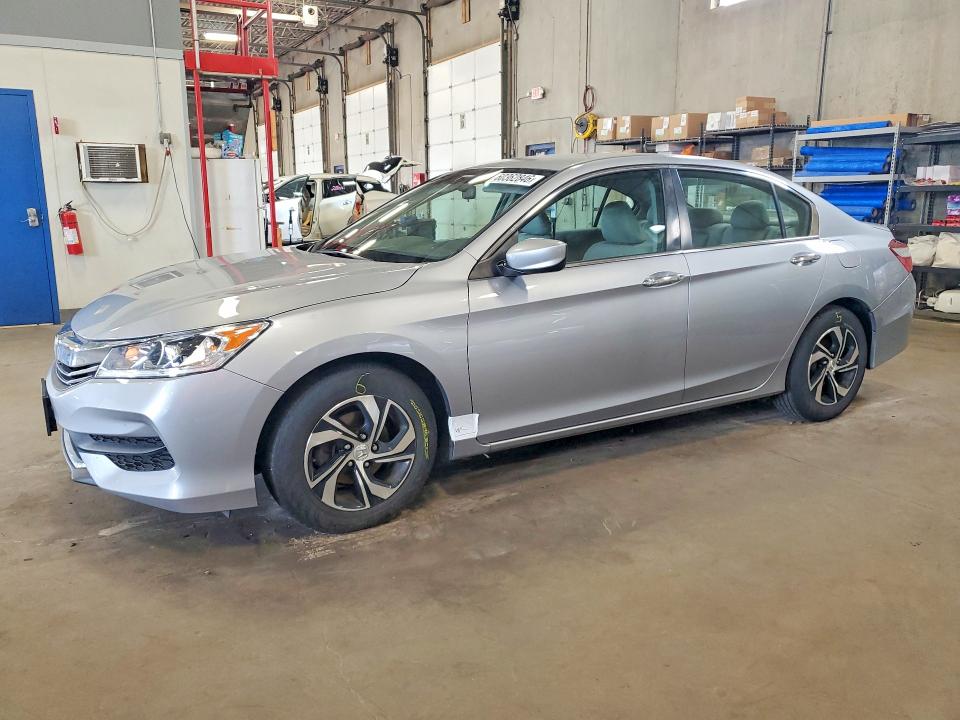
2016 Honda Accord LX Flood Salvage: $300 Bid, $11K Mistake
You can't register a salvage flood car in 11 states. Check yours before the $300 clears.
How is the Shame Score calculated?
The Shame Score (1–10) combines five signals: damage-type severity, title-condition risk, the gap between ACV (Actual Cash Value — the car's pre-damage market price) and AI max bid, listing red flags (run/drive status, secondary damage), and misleading-listing signals from AI photo analysis. A score of 8+ means the model found no financially defensible reason to bid. ACV is pulled from auction listing data; repair costs reference industry body-shop benchmarks. All figures are directional estimates, not binding quotes. Repair costs reference CCC Intelligent Solutions benchmarks and regional body-shop averages.
Would you bid?
Vehicle
2016 HONDA ACCORD
Title
salvage
Damage
WATER/FLOOD
State
Minnesota
Mileage
100-150k
Runs/drives
—
Approx ACV
~$11,000
AI max bid
$0
ACV from auction listing data · Repair costs via CCC benchmarks + body-shop averages
In plain numbers: Someone is bidding ~$9,900+ on this vehicle. AI analysis says it's worth at most $0 as a project. That's a $11,000gap. Here's why.
A 2016 Honda Accord LX with a key in hand, 138,000 miles on the clock, and a current bid of $300. Three hundred dollars. For an Accord. The brain does the math automatically — these things run forever, parts are everywhere, your cousin's mechanic knows them cold. At $300 you're basically stealing it. The ACV (Actual Cash Value — what it was worth before the damage) sits at $11,300, which means there's theoretically $11,000 of car here waiting to be unlocked. You start doing the fantasy math. You always start doing the fantasy math.
The listing says water/flood for primary damage and leaves secondary damage blank. That blank is doing a lot of work. Flood cars don't have one damage category — they have a timeline. Water comes in, soaks the carpet, climbs the seat foam, finds the ECU (the engine control unit — the car's main computer, mounted low on the firewall in this generation Accord), wicks into the connector pins, and then dries. The car looks fine. Smells a little. Then six weeks later the ABS module starts throwing codes, the power window regulator seizes, the airbag control module logs a fault it will never clear, and the transmission begins hunting between gears because the solenoid pack is corroding from the inside. None of that shows up in the primary damage field.
Here's what the math actually looks like. ECU replacement and reprogramming $1,200. Full wiring harness inspection and repair — if you find a shop willing to touch a flood car — $800 to $2,400 depending on what they find. Airbag control module $600, and that's before you know if the bags deployed or the sensors are just corrupted. Transmission service plus solenoid inspection $400, replacement if the solenoid pack is gone $1,800. Mold remediation and interior strip-and-dry $1,500 minimum, $3,000 if it's been sitting. Salvage title (legally declared a total loss by an insurance company) rebrand inspection fees vary by state, $150 to $500, and in some states it simply cannot be rebranded at all. Add $300 bid + $350 auction fees + $200 transport and you're at $850 before you've smelled the interior. Conservative repair estimate: $6,500 to $9,400. You are not buying an $11,300 car for $300. You are buying a $7,000 problem for $850.
Someone is going to win this auction and feel like a genius for four days. Then they'll pull the carpet back. Deanna in Stockton is going to bid on this and spend the next three months arguing with a title clerk about whether Georgia flood salvage transfers to California. The Accord underneath the damage is a fine car. The damage is not underneath anything — it's in every connector, every module, every seam of insulation that soaked up whatever that water carried with it. Pass.
“The carpets are drier than the title history.”
What to watch for: WATER/FLOOD
- •Pull the driver's side carpet back at the rear of the footwell and press the padding with your hand. If it's cold, dense, or releases any moisture, the car has been wet recently or never properly dried. Dry flood cars still fail this test for months.
- •Find the ECU — on this generation Accord it's bolted to the firewall behind the glove box, low. Look at the connector pins with a flashlight. Green or white oxidation on any pin means water reached it. That module is $800 to $1,200 and reprogramming is extra.
- •Open every door and look at the bottom of the door card where it meets the sill. Flood water traps behind plastic panels and grows mold in the foam backing. If the door cards smell musty when you press your nose to the seam, the interior remediation is not done — it hasn't started.
- •Check the seat rail bolts on the underside of both front seats. Rust on those bolts tells you how high the water got and how long it sat. Surface rust means a quick flood. Flaking, pitted rust means it soaked.
- •Plug in an OBD-II scanner (a $30 code reader from any auto parts store) and look at the number of stored fault codes across all modules, not just the engine. A clean flood car will still show 6 to 15 codes in body, transmission, and airbag modules. More than that and the electrical damage is already cascading.
Tomorrow’s lot. Before the auction. Free.
One lot. AI verdict. Max bid. The numbers that matter — before you bid.
Not bidding? Same email — one lot, one roast, every morning. Join readers who watch so they never bid blind.
Not ready? Browse all entries →TL;DR — copy & share
2016 HONDA ACCORD / WATER/FLOOD / Minnesota / ACV ~$11,000 Shame Score: 8.2/10 | AI Max Bid: $0 The carpets are drier than the title history. vetmyride.com/hall-of-shame/2016-honda-accord-lx-flood-salvage-bid-k-mistake-60362846
Previous entry
2017 LINCOLN MKT · Shame 8.2
“The sunroof works great. The roof it's attached to is a different conversation.”
Lot identifying info (lot number, VIN, seller, exact sale date) scrubbed. AI commentary is opinion based on publicly listed damage + auction signals. Always inspect in person before bidding.
AI-generated opinion based on publicly listed auction data. Not a factual vehicle assessment. Actual vehicle condition may differ from listing description. All figures are directional estimates, not binding quotes. VetMyRide is not affiliated with, endorsed by, or sponsored by any auction platform. Not a substitute for professional inspection.