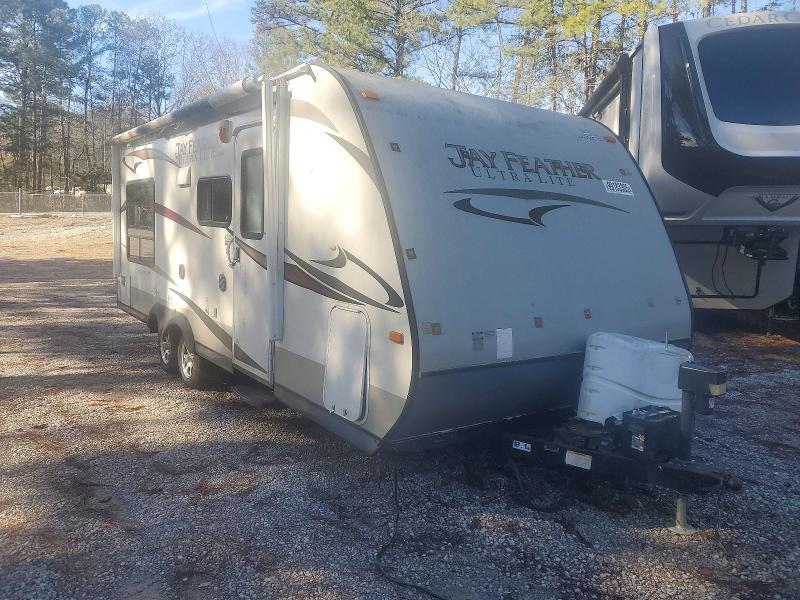
2013 Jayco Jay Feather Ultra Lite Camper: Salvage Title After Fire
You can't insure a burned salvage camper. Most campgrounds won't accept it. You'll own a charred box with nowhere to go.
How is the Shame Score calculated?
The Shame Score (1–10) combines five signals: damage-type severity, title-condition risk, the gap between ACV (Actual Cash Value — the car's pre-damage market price) and AI max bid, listing red flags (run/drive status, secondary damage), and misleading-listing signals from AI photo analysis. A score of 8+ means the model found no financially defensible reason to bid. ACV is pulled from auction listing data; repair costs reference industry body-shop benchmarks. All figures are directional estimates, not binding quotes. Repair costs reference CCC Intelligent Solutions benchmarks and regional body-shop averages.
Would you bid?
Vehicle
2013 JAYCO JAY FEATH
Title
salvage
Damage
BURN
State
Alabama
Mileage
—
Runs/drives
—
AI max bid
$0
ACV from auction listing data · Repair costs via CCC benchmarks + body-shop averages
A 2013 Jayco Jay Feather Ultra Lite. Aluminum frame, lightweight construction, the kind of camper that made weekend warriors feel like they'd figured something out — tow it with a half-ton, set up in forty minutes, sleep under the stars. These were genuinely good units. Practical. Popular. The resale market on clean examples is real. And the bid is sitting at zero dollars, which means you could theoretically own a Jayco travel trailer for less than a tank of gas.
The damage category is BURN. Not 'minor fire.' Not 'smoke.' Burn. On a camper built around aluminum framing, fiberglass panels, foam insulation, vinyl flooring, and laminated cabinetry — materials that don't survive fire the way steel does, materials that absorb smoke and off-gas for years, materials where the visible char is never the whole story. The listing offers no secondary damage, no run/drive condition, no keys, no mileage, no ACV. Every single field that would tell you what you're buying is blank. That's not an oversight. That's the listing.
Fire restoration on a travel trailer is not a repair category — it's a demolition project with optimism attached. Aluminum framing that's been heat-stressed loses structural integrity invisibly; you can't see the weakness, you find it when a wall flexes wrong at 65 mph. Foam core panels that absorbed smoke will off-gas formaldehyde and char smell indefinitely, no matter how many times you clean them. Wiring in a burned RV is a full replacement job — $3,000 to $6,000 for a unit this size — because heat travels through wire insulation long past the visible burn zone. If the propane system was involved, every line, fitting, regulator, and appliance connection gets replaced or the unit is a rolling explosion waiting for a spark. New laminated wall panels run $800 to $1,500 per section. Flooring, cabinetry, roof membrane — add $4,000 to $8,000 depending on burn extent. Total realistic restoration: $12,000 to $20,000, on a camper whose clean ACV was maybe $8,000 to $10,000 before the fire. And when you're done, you still have a salvage-titled RV that no reputable campground's insurance policy will allow on their property, that no insurer will cover for full replacement value, and that you cannot sell to anyone who does their homework.
Someone is going to bid on this because the number starts at zero and the brain does something stupid with free. That person — Derek, somewhere in the mid-South — is going to haul it home on a borrowed trailer and spend the next two summers finding new ways the fire won. The campgrounds will turn him away. The insurer will laugh. The propane fittings will keep him up at night. Zero dollars is the correct bid. It is also the correct final bid.
“The only thing 'Ultra Lite' about this camper now is the structural integrity.”
What to watch for: BURN
- •Press your thumb into every wall panel you can reach. Burned foam core delaminate from the interior skin — if the wall flexes or feels hollow in patches, the structural panel is gone and that entire wall section needs replacement.
- •Get under the frame and look at the aluminum crossmembers near the burn origin. Heat-stressed aluminum develops micro-fractures you can't see but will feel when the frame flexes under tow. Look for discoloration, warping, or any member that looks like it was bent and straightened.
- •Pull up a corner of flooring near the burn zone. Smell it, then smell the subfloor. If the subfloor has any char odor or soft spots, the entire floor deck is compromised — RV subfloor is typically luaun plywood, and once it's absorbed fire moisture and smoke, it rots from underneath while looking passable on top.
- •Check every propane fitting, valve, and appliance connection with soapy water and a brush even if the system looks untouched. Heat travels through copper and aluminum lines far beyond the visible burn area, and compromised fittings won't show damage until there's pressure in the line.
- •Look at the roof membrane from the outside. Fire and heat cause RV roof membranes to bubble, crack, and separate from the decking. Any breach in the roof membrane means every rain since the fire has been adding water damage to the fire damage.
Tomorrow’s lot. Before the auction. Free.
One lot. AI verdict. Max bid. The numbers that matter — before you bid.
Not bidding? Same email — one lot, one roast, every morning. Join readers who watch so they never bid blind.
Not ready? Browse all entries →TL;DR — copy & share
2013 JAYCO JAY FEATH / BURN / Alabama / ACV ~$? Shame Score: 9.2/10 | AI Max Bid: $0 The only thing 'Ultra Lite' about this camper now is the structural integrity. vetmyride.com/hall-of-shame/2013-jayco-jay-feather-ultra-lite-camper-salvage-title-after-fire
Previous entry
2006 CHRYSLER MINIVAN · Shame 9.2
“Unknown title, unknown mileage, unknown if it has keys — known fire.”
Lot identifying info (lot number, VIN, seller, exact sale date) scrubbed. AI commentary is opinion based on publicly listed damage + auction signals. Always inspect in person before bidding.
AI-generated opinion based on publicly listed auction data. Not a factual vehicle assessment. Actual vehicle condition may differ from listing description. All figures are directional estimates, not binding quotes. VetMyRide is not affiliated with, endorsed by, or sponsored by any auction platform. Not a substitute for professional inspection.