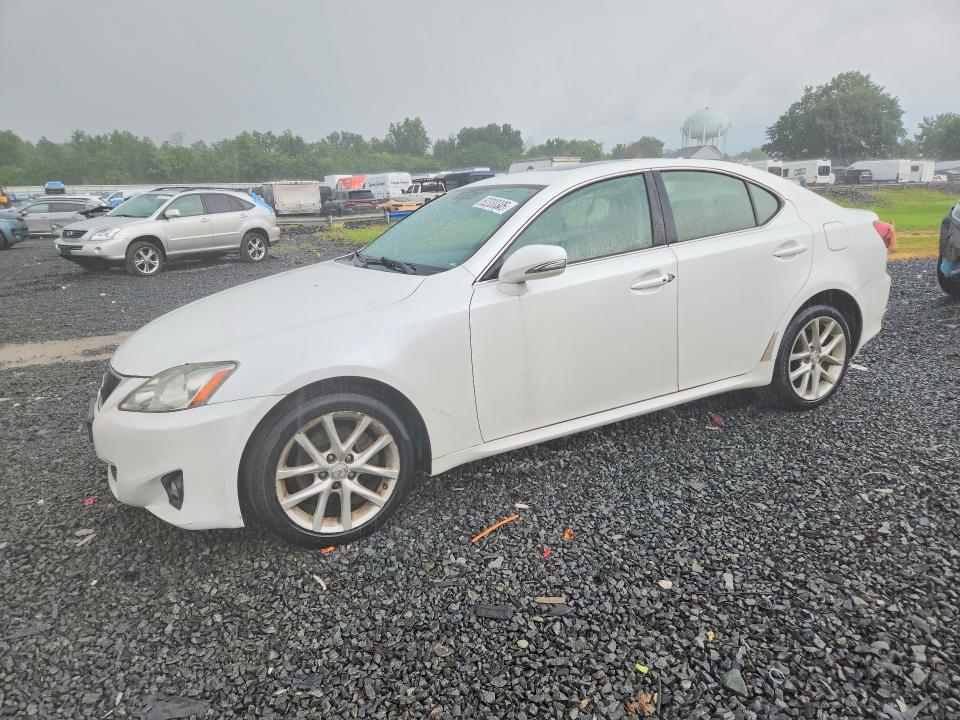
2011 Lexus IS 250 Flood Salvage: $11,975 ACV, $0 Answers
Flood cars don't die — they rot slowly, and this one won't even tell you how long it's been rotting.
How is the Shame Score calculated?
The Shame Score (1–10) combines five signals: damage-type severity, title-condition risk, the gap between ACV (Actual Cash Value — the car's pre-damage market price) and AI max bid, listing red flags (run/drive status, secondary damage), and misleading-listing signals from AI photo analysis. A score of 8+ means the model found no financially defensible reason to bid. ACV is pulled from auction listing data; repair costs reference industry body-shop benchmarks. All figures are directional estimates, not binding quotes. Repair costs reference CCC Intelligent Solutions benchmarks and regional body-shop averages.
Would you bid?
Vehicle
2011 LEXUS IS
Title
salvage
Damage
WATER/FLOOD
State
New Jersey
Mileage
—
Runs/drives
—
Approx ACV
~$12,000
AI max bid
$0
ACV from auction listing data · Repair costs via CCC benchmarks + body-shop averages
In plain numbers: Someone is bidding ~$10,800+ on this vehicle. AI analysis says it's worth at most $0 as a project. That's a $12,000gap. Here's why.
An IS 250 at zero dollars bid. That's the number that gets people. Lexus badge, rear-wheel drive, one of the cleaner-looking sports sedans Toyota ever built — and someone is going to see that $0 and feel like they found a secret. The ACV (Actual Cash Value — what the car was worth before the water got to it) sits at $11,975, which means the market agrees this was a real car once. A desirable one. You can feel the logic assembling itself: buy it cheap, dry it out, flip it. Clean it up. Drive it.
The listing gives you nothing to kill that logic with. Mileage: unknown. Run/drive: unknown. That's not a disclosure — that's a blindfold. With flood cars, unknown mileage means the cluster is either fried or someone pulled it. Unknown run/drive on a water-damaged vehicle means either the engine hydrolocked (water entered the cylinders, pistons tried to compress it, something bent that doesn't unbend) or they simply won't start it because of what might happen when they do. The listing doesn't say which. It doesn't have to. You're the one who has to find out.
The IS 250 runs a 2.5L V6 with a six-speed automatic — a transmission that does not appreciate being submerged. Full fluid flush and rebuild on that unit runs $2,800 to $3,500 depending on what the water destroyed internally. The wiring harness on this generation Lexus is dense and runs low in the cabin; corrosion in connectors causes faults that surface weeks after the car seems fine. Mold remediation on a flooded interior — if the car sat — is $1,500 to $2,100 before you touch anything mechanical. ECU replacement or refurbishment, $900 to $1,400. The salvage title (legally declared a total loss by an insurance company) follows this car forever, cutting resale value by 40 to 60 percent against a clean example. Transmission $3,200 + wiring $1,800 + mold $2,000 + ECU $1,200 + paint corrosion at the door bottoms $800 = $9,000 before you've confirmed the engine turns freely.
Someone is going to bid on this because the opening number is zero and the badge says Lexus. They will win it for somewhere between $1,500 and $3,500, feel victorious for about four days, and then meet the repair list. The salvage title means they can't easily finance it, can't easily insure it at full value, and can't easily sell it to anyone who does their homework. Sandra in Marietta is going to drive two hours to pick this up and spend the next six months explaining to people why her Lexus smells like that.
“The only dry thing on this Lexus is the auction listing.”
What to watch for: WATER/FLOOD
- •Pull the driver's seat and press your palm flat against the carpet padding underneath. If it's cold, damp, or stiff in a way that dried carpet isn't, the floor pan held water long enough to start rusting from the inside out.
- •Find the OBD-II port (under the dash, driver's side) and plug in a scanner before you do anything else. Flood cars accumulate fault codes across every module — body control, transmission, ABS, SRS. A clean engine with 30 stored codes is still a car that's going to strand you.
- •Check the seat belt pretensioners on both front seats. Flood water triggers them on some vehicles. A deployed pretensioner looks fine visually but won't function in a crash, and replacement runs $400 to $700 per side.
- •Look at the tops of the interior door panels, not the bottoms. Water leaves a tide line — a faint discoloration or warping along the trim. Sellers clean the floor. They rarely think to clean six inches above where the water stopped.
- •Pull the spare tire cover in the trunk. Water pools there and sits. If the spare well smells like a basement or shows rust blooms on the metal, the car soaked longer than anyone will admit.
Tomorrow’s lot. Before the auction. Free.
One lot. AI verdict. Max bid. The numbers that matter — before you bid.
Not bidding? Same email — one lot, one roast, every morning. Join readers who watch so they never bid blind.
Not ready? Browse all entries →TL;DR — copy & share
2011 LEXUS IS / WATER/FLOOD / New Jersey / ACV ~$12,000 Shame Score: 8.7/10 | AI Max Bid: $0 The only dry thing on this Lexus is the auction listing. vetmyride.com/hall-of-shame/2011-lexus-is-250-flood-salvage-acv-answers-62330386
Previous entry
2008 GMC SIERRA · Shame 7.8
“The frame is the truck. Everything else is just cargo.”
Lot identifying info (lot number, VIN, seller, exact sale date) scrubbed. AI commentary is opinion based on publicly listed damage + auction signals. Always inspect in person before bidding.
AI-generated opinion based on publicly listed auction data. Not a factual vehicle assessment. Actual vehicle condition may differ from listing description. All figures are directional estimates, not binding quotes. VetMyRide is not affiliated with, endorsed by, or sponsored by any auction platform. Not a substitute for professional inspection.