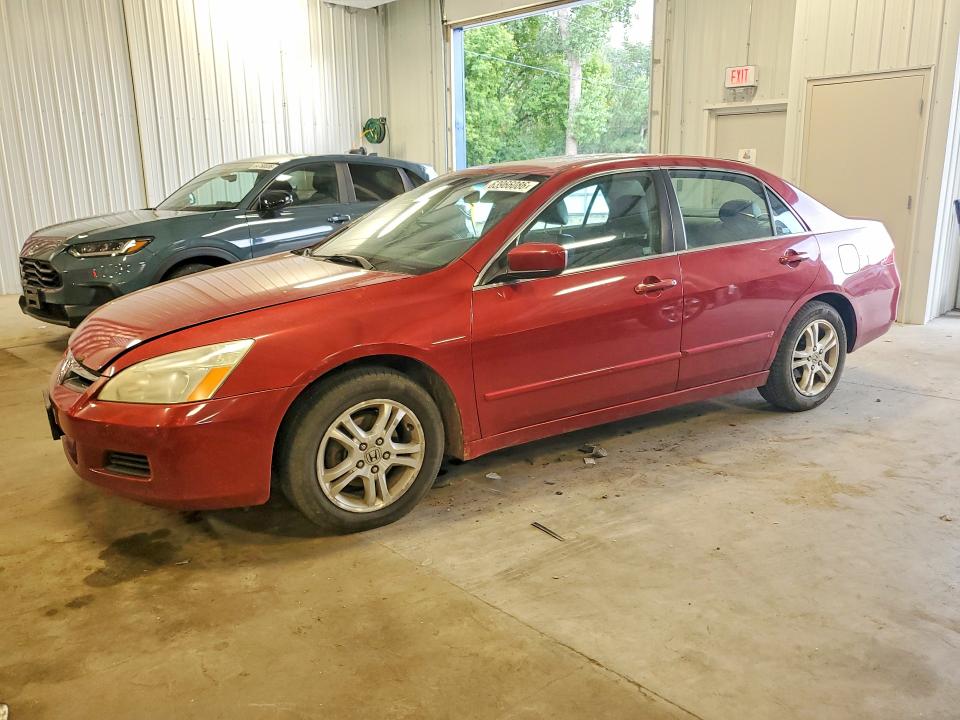
2007 Honda Accord EX Salvage: Roof Crush at 126K Isn't a Deal
Roof crush means bent A-pillars — and a car that failed to protect its last occupant.
How is the Shame Score calculated?
The Shame Score (1–10) combines five signals: damage-type severity, title-condition risk, the gap between ACV (Actual Cash Value — the car's pre-damage market price) and AI max bid, listing red flags (run/drive status, secondary damage), and misleading-listing signals from AI photo analysis. A score of 8+ means the model found no financially defensible reason to bid. ACV is pulled from auction listing data; repair costs reference industry body-shop benchmarks. All figures are directional estimates, not binding quotes. Repair costs reference CCC Intelligent Solutions benchmarks and regional body-shop averages.
Would you bid?
Vehicle
2007 HONDA ACCORD
Title
salvage
Damage
TOP/ROOF
State
Minnesota
Mileage
100-150k
Runs/drives
Yes
Approx ACV
~$6,000
AI max bid
$0
ACV from auction listing data · Repair costs via CCC benchmarks + body-shop averages
In plain numbers: Someone is bidding ~$5,400+ on this vehicle. AI analysis says it's worth at most $0 as a project. That's a $6,000gap. Here's why.
A 2007 Accord EX with 126,000 miles that runs and drives. On paper, this is the car your uncle swears by — Honda reliability, a trim level with real features, and a bid sitting at $1,000. The ACV (Actual Cash Value — what it was worth before the wreck) is $6,175, which means there's theoretically $5,000 of room to work with. You start doing the math. You start feeling optimistic. That's the trap.
The damage is listed as TOP/ROOF. That sounds contained, like maybe a hail event or a low-clearance garage. It is not. Roof damage on a sedan means the structural crush zone — the part engineers spent decades designing to keep the cabin intact during a rollover — failed. When a roof folds, it takes the A-pillars with it. A-pillars are what hold your windshield and, more relevantly, what keep the roof from meeting the headrests during a second impact. The listing says it runs and drives. It says nothing about whether the doors still close square, whether the windshield is delaminating at the seal, or whether the unibody is torqued in a way that no alignment rack will ever fully fix.
Roof straightening on a unibody sedan is not a panel job — it's a structural repair. A certified body shop will quote you $4,500 to $7,000 for the metalwork alone, assuming the A-pillars aren't kinked past the point of repair, which on a rollover-adjacent crush they frequently are. Add a windshield at $350, an alignment at $180, and a pre-purchase inspection from someone who actually puts it on a frame rack at $150. If the pillars need sectioning, you're looking at another $2,000 minimum and a repair that most insurers won't touch. Frame rack inspection $150 + roof structural repair $5,750 + windshield $350 + alignment $180 + pillar sectioning $2,000 = $8,430 before you've replaced the seatbelts — which, on any car that's been in a rollover, are single-use and legally required to be replaced at $200 to $400 per corner.
Someone is going to bid $1,800 on this and drive it home feeling like they won something. They will register it on a salvage title (legally declared a total loss by an insurance company), which means diminished resale value forever, difficulty getting full-coverage insurance, and a car that failed a structural test once and has never been certified to have passed one since. Denise in Marietta is going to put her kids in the back seat of this thing and not think about it once.
“The airbags deployed. The roof didn't.”
What to watch for: TOP/ROOF
- •Stand at each corner of the car and sight down the roofline. Any visible bow, ripple, or asymmetry in the crush zone means the pillars moved — and moving pillars mean a frame rack, not a body hammer.
- •Open all four doors and check the gaps at the top corners where the door meets the roof rail. Uneven gaps wider than a pencil thickness mean the body has racked and realigned doors are masking a structural shift.
- •Check the headliner at the B-pillar (the pillar between the front and rear doors). Wrinkled or bubbled headliner fabric there is a compression signature — the roof folded inward and the interior trim is telling you exactly where.
- •Pull back the carpet at the base of the A-pillars on both sides. Cracked seam sealer or paint transfer inside the footwell means the pillar base moved during the event — that's a structural repair, not a cosmetic one.
- •Ask for the insurance total-loss report if available. Roof crush events are frequently rollovers. A rollover that 'only' damaged the roof is a car that landed on its roof. That changes every calculation.
Tomorrow’s lot. Before the auction. Free.
One lot. AI verdict. Max bid. The numbers that matter — before you bid.
Not bidding? Same email — one lot, one roast, every morning. Join readers who watch so they never bid blind.
Not ready? Browse all entries →TL;DR — copy & share
2007 HONDA ACCORD / TOP/ROOF / Minnesota / ACV ~$6,000 Shame Score: 7.5/10 | AI Max Bid: $0 The airbags deployed. The roof didn't. vetmyride.com/hall-of-shame/2007-honda-accord-ex-salvage-roof-crush-at-126k-isn-t-a-deal-63966086
Previous entry
2019 CHEVROLET EQUINOX · Shame 9.2
“No keys, no title, no idea — and somehow the bid is the least unknown thing about it.”
Lot identifying info (lot number, VIN, seller, exact sale date) scrubbed. AI commentary is opinion based on publicly listed damage + auction signals. Always inspect in person before bidding.
AI-generated opinion based on publicly listed auction data. Not a factual vehicle assessment. Actual vehicle condition may differ from listing description. All figures are directional estimates, not binding quotes. VetMyRide is not affiliated with, endorsed by, or sponsored by any auction platform. Not a substitute for professional inspection.