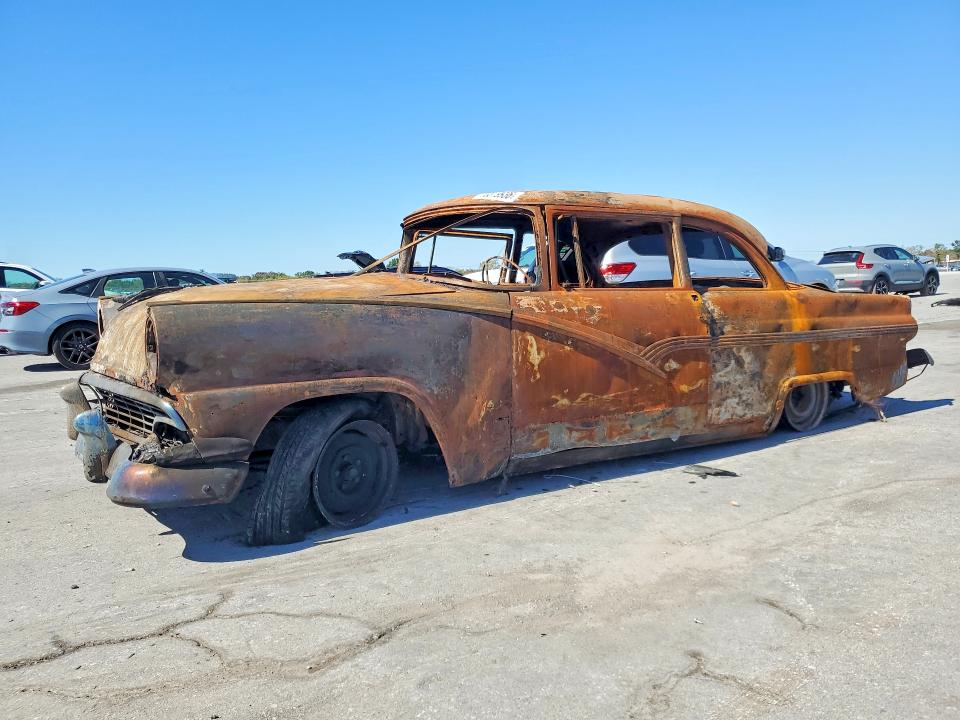
1956 Ford Fairlane: Fire Damage, Unknown Title, Zero Answers
You can't register a car with no title. You especially can't register a burned one.
How is the Shame Score calculated?
The Shame Score (1–10) combines five signals: damage-type severity, title-condition risk, the gap between ACV (Actual Cash Value — the car's pre-damage market price) and AI max bid, listing red flags (run/drive status, secondary damage), and misleading-listing signals from AI photo analysis. A score of 8+ means the model found no financially defensible reason to bid. ACV is pulled from auction listing data; repair costs reference industry body-shop benchmarks. All figures are directional estimates, not binding quotes. Repair costs reference CCC Intelligent Solutions benchmarks and regional body-shop averages.
Would you bid?
Vehicle
1956 FORD FAIRLANE
Title
unknown
Damage
BURN
State
Tennessee
Mileage
—
Runs/drives
—
AI max bid
$0
ACV from auction listing data · Repair costs via CCC benchmarks + body-shop averages
A 1956 Ford Fairlane sits at $0. Zero. The bid sheet is blank and the buy-now doesn't exist, which means the auction house itself hasn't committed to a number. That's the first thing you should notice. These cars — two-tone paint, chrome eyebrows over the headlights, that long hood that made teenagers feel like adults — they move. A clean '56 Fairlane Town Sedan pulls $18,000 to $28,000 depending on the day and the crowd. A Victoria hardtop with a decent drivetrain clears $35,000 without trying. The photos probably show good bones. You're already doing the math.
The listing says burn damage. It does not say where. It does not say how much. It does not say whether the fire started in the engine bay, the interior, the trunk, or whether this car sat in a garage while the garage burned around it. Those are four completely different cars with four completely different outcomes. Fire that starts under the hood cooks wiring looms, fuel lines, and the firewall. Fire that starts in the interior turns horsehair padding and original headliner into accelerant and then takes the dash, the door panels, and every rubber grommet in the car. The listing knows which one this is. The listing is not telling you.
No title means you are buying a burned hulk with no legal path to ownership in most states. Not a slow path. No path. Title recovery on a vehicle this old varies by state but commonly requires a bonded title process — 3 to 18 months, $300 to $1,500 in fees, and a surety bond calculated at 1.5x the appraised value. Appraised value on a burned '56 Fairlane with unknown damage is whatever the appraiser feels like that morning. Then the fire damage itself: even optimistic restoration math on a car this age looks like $8,000 to $14,000 for a partial interior rebuild, $3,500 to $6,000 for wiring harness fabrication because nobody stocks original looms, $2,200 for firewall repair if the metal is compromised, and that's before you've addressed whatever mechanical damage the heat caused. If the gas tank cooked, add $800 and pray the frame rails aren't warped. Frame straightening on a unibody-era chassis: $4,500 minimum. You're at $19,000 to $28,500 in restoration costs chasing a car you don't legally own yet.
Somebody in Phoenix is going to bid on this because the photos show the chrome is mostly intact. Teresa in Phoenix is going to spend the next four years and $31,000 discovering that chrome survives fires better than everything underneath it. The car will sit in a rented storage unit while the title bond clears, then sit longer while she finds a shop that works on '56 Fords, then sit longer while that shop finds someone who fabricates wiring harnesses. The chrome will still look great at every stage of this.
“Unknown title, unknown mileage, unknown if it runs — known fire.”
What to watch for: BURN
- •Look at the firewall — the vertical metal panel separating the engine bay from the interior. If it's bubbled, warped, or shows heat discoloration on the interior side, the fire crossed over. That means wiring, pedal assemblies, and HVAC are compromised and you're looking at a full firewall restoration.
- •Pull back whatever's left of the floor carpet or padding near the driver's seat and transmission tunnel. Fire-damaged cars trap water from suppression efforts. If the floor pan shows rust blooms or the metal flexes when you press it, the structure is already rotting underneath the visible damage.
- •Check the frame rails under the car with a flashlight — on a '56 Fairlane look for the full-length ladder frame. Heat warps steel. Run your eye along the rail from front to rear; any visible bow or twist means frame straightening before anything else happens, and on a 68-year-old frame that's not a repair, that's a decision about whether the car is worth saving.
- •Inspect every rubber grommet, fuel line, and brake line you can see. Heat degrades rubber without burning it visibly. A brake line that looks intact after a fire can fail under pressure the first time you stop hard. On a car this age, assume all rubber is compromised and budget a full brake and fuel line replacement regardless of what you see.
- •On the title: before you bid, run the VIN through your state DMV's lien and title search. A 1956 vehicle with a fire claim and no title has likely been through at least one insurance transaction. Find out if a total-loss (a formal insurance declaration that the car's repair cost exceeds its value) was ever filed — because if it was and the title was never properly reissued, you may be buying into a title that can never be made clean regardless of what the bonding process says.
Tomorrow’s lot. Before the auction. Free.
One lot. AI verdict. Max bid. The numbers that matter — before you bid.
Not bidding? Same email — one lot, one roast, every morning. Join readers who watch so they never bid blind.
Not ready? Browse all entries →TL;DR — copy & share
1956 FORD FAIRLANE / BURN / Tennessee / ACV ~$? Shame Score: 9.2/10 | AI Max Bid: $0 Unknown title, unknown mileage, unknown if it runs — known fire. vetmyride.com/hall-of-shame/1956-ford-fairlane-fire-damage-unknown-title-zero-answers-70379936
Previous entry
2024 TOYOTA TACOMA · Shame 8.7
“Toyota built it to take a beating. The previous owner found one it couldn't.”
Lot identifying info (lot number, VIN, seller, exact sale date) scrubbed. AI commentary is opinion based on publicly listed damage + auction signals. Always inspect in person before bidding.
AI-generated opinion based on publicly listed auction data. Not a factual vehicle assessment. Actual vehicle condition may differ from listing description. All figures are directional estimates, not binding quotes. VetMyRide is not affiliated with, endorsed by, or sponsored by any auction platform. Not a substitute for professional inspection.