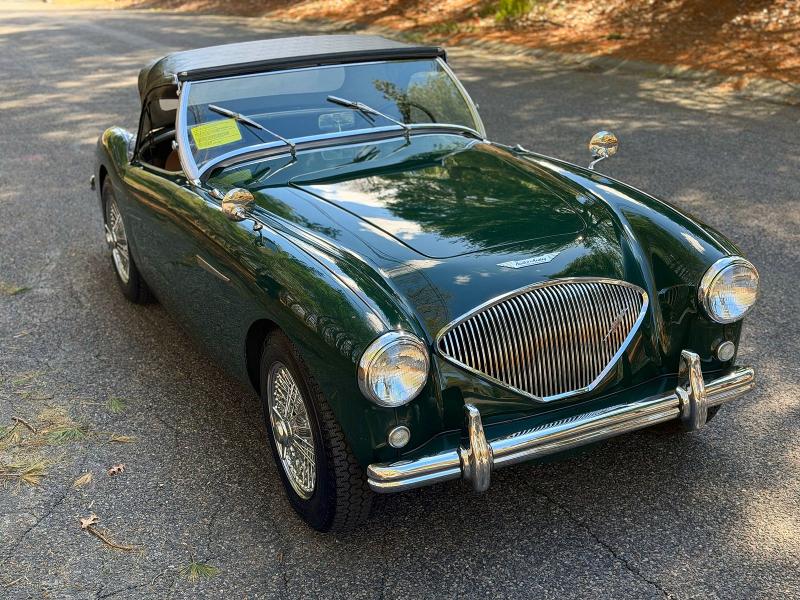
1953 Austin-Healey 100-4: 8,476 Miles, Clean Title, $55K Ask, No ACV
No ACV on a 70-year-old British roadster means nobody — not even the seller — knows what this is worth.
How is the Shame Score calculated?
The Shame Score (1–10) combines five signals: damage-type severity, title-condition risk, the gap between ACV (Actual Cash Value — the car's pre-damage market price) and AI max bid, listing red flags (run/drive status, secondary damage), and misleading-listing signals from AI photo analysis. A score of 8+ means the model found no financially defensible reason to bid. ACV is pulled from auction listing data; repair costs reference industry body-shop benchmarks. All figures are directional estimates, not binding quotes. Repair costs reference CCC Intelligent Solutions benchmarks and regional body-shop averages.
Would you bid?
Vehicle
1953 AUST 100-4
Title
clean
Damage
NORMAL WEAR
State
Massachusetts
Mileage
under 25k
Runs/drives
Yes
AI max bid
$0
ACV from auction listing data · Repair costs via CCC benchmarks + body-shop averages
A 1953 Austin-Healey 100-4 at 8,476 miles. One of the most beautiful cars ever bolted together in Longbridge — inline four, two seats, a body that still makes people stop walking. The 100-4 is the car that launched the Healey legend, and low-mileage survivors with clean titles trade hands for serious money among people who know what they're looking at. The buy-now is $55,000. The current bid is $33,500. For a genuine, sorted, documented example, either number is not insane. That's the trap.
Copart declined to assign an ACV (Actual Cash Value — what the car is worth before any damage or issues). On a modern car, a missing ACV is a yellow flag. On a 71-year-old British sports car listed under 'normal wear,' it is the auction house quietly stepping out of the room. 'Normal wear' on a vehicle from the Eisenhower administration is not a damage category — it's a philosophical position. What does 8,476 miles mean on a car that has existed for seven decades? Are those miles from new, or from the last engine rebuild? Has it been stored, driven, restored, or 'restored'? The listing does not say. The listing is not going to say.
Here is what a 100-4 can cost you when the details emerge after the hammer falls. A proper engine rebuild on the BN1/BN2 four-cylinder runs $6,000–$9,000 from a specialist. Correct-specification wire wheels, if these aren't original: $2,800–$4,500 for a set. A full brake system overhaul on the four-wheel drums — not optional on a car you plan to drive — is $1,800–$2,400. Rust remediation on the inner sills and floor sections, which rot invisibly under original-looking carpets on every 100-4 that ever saw British weather or a damp garage: $3,500–$8,000 depending on how far it's gone. Electrical system sorting on Lucas-wired cars of this era is not a line item, it's a lifestyle. Budget $1,500 and double it. That's $15,600–$25,900 before you've addressed whatever 'normal wear' actually means on a car born before the Korean War ended. Add that to a $33,500 bid and you are at $49,100–$59,400 for a car with no documented history and no independent appraisal.
A legitimate 100-4 with provenance, a Heritage Certificate, documented restoration receipts, and a pre-purchase inspection from a marque specialist — that car is worth $55,000. This is not described as that car. Somebody is going to bid $33,500 on the romance of the thing, skip the inspection because 'it runs and drives,' and discover over the next two years that the floors are held together by carpet and optimism.
Diana in Scottsdale is going to win this at $38,000 and spend the next three years and $22,000 finding out what 'normal wear' meant.
“The auction house declined to appraise it. That's the appraisal.”
What to watch for: NORMAL WEAR
- •Pull back the carpet and floor mats completely — press your thumb into the floor pan in the footwells and along the inner sills. On a 100-4, rust perforation here is common and invisible under original-looking interior. If it flexes, it's gone.
- •Check the frame outriggers under the body at the sill line with a screwdriver. These are the first structural pieces to rot on a 100-4 and the most expensive to repair correctly. Poke, don't just look.
- •Ask for the Heritage Certificate from the British Motor Museum. A genuine low-mileage survivor will have documented production records. No certificate means no provenance, which means the mileage and history are stories, not facts.
- •Run the engine to full operating temperature and watch for oil weeping at the rear main seal and around the tappet chest cover. These are the two most common failure points on the BN1/BN2 engine after a long storage period, and both signal a rebuild is coming.
- •Inspect the wire wheels — if fitted — for broken or loose spokes by running a key around the rim while spinning slowly. Cracked splines on the knock-off hubs are a safety issue, not a cosmetic one, and a correct replacement set is not cheap.
Tomorrow’s lot. Before the auction. Free.
One lot. AI verdict. Max bid. The numbers that matter — before you bid.
Not bidding? Same email — one lot, one roast, every morning. Join readers who watch so they never bid blind.
Not ready? Browse all entries →TL;DR — copy & share
1953 AUST 100-4 / NORMAL WEAR / Massachusetts / ACV ~$? Shame Score: 7.8/10 | AI Max Bid: $0 The auction house declined to appraise it. That's the appraisal. vetmyride.com/hall-of-shame/1953-austin-healey-100-4-clean-title-k-ask-no-acv
Previous entry
2015 HONDA CIVIC · Shame 6.5
“Two hundred thousand miles and it still found a way to make things worse.”
Lot identifying info (lot number, VIN, seller, exact sale date) scrubbed. AI commentary is opinion based on publicly listed damage + auction signals. Always inspect in person before bidding.
AI-generated opinion based on publicly listed auction data. Not a factual vehicle assessment. Actual vehicle condition may differ from listing description. All figures are directional estimates, not binding quotes. VetMyRide is not affiliated with, endorsed by, or sponsored by any auction platform. Not a substitute for professional inspection.