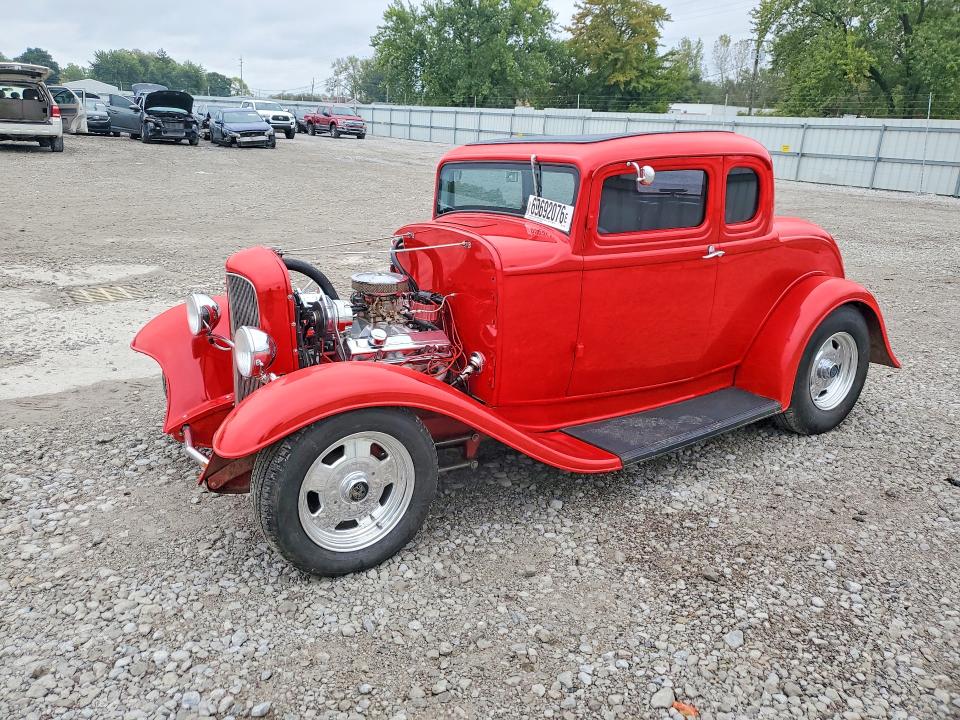
1932 Ford Coupe With Salvage Title and Frame Damage Wants $8,100
A bent frame on a 93-year-old car isn't a repair — it's a death sentence for a piece of history.
How is the Shame Score calculated?
The Shame Score (1–10) combines five signals: damage-type severity, title-condition risk, the gap between ACV (Actual Cash Value — the car's pre-damage market price) and AI max bid, listing red flags (run/drive status, secondary damage), and misleading-listing signals from AI photo analysis. A score of 8+ means the model found no financially defensible reason to bid. ACV is pulled from auction listing data; repair costs reference industry body-shop benchmarks. All figures are directional estimates, not binding quotes. Repair costs reference CCC Intelligent Solutions benchmarks and regional body-shop averages.
Would you bid?
Vehicle
1932 FORD COUPE
Title
salvage
Damage
FRAME DAMAGE
State
Ohio
Mileage
50-100k
Runs/drives
Yes
AI max bid
$0
ACV from auction listing data · Repair costs via CCC benchmarks + body-shop averages
A 1932 Ford Coupe. Flathead V8 country, running boards, suicide doors, the car that made hot rodders out of teenagers for the next five decades. Fifty-five thousand miles — and on a car this age, you don't know if that's original, rolled once, or rolled four times across three odometers that rotted out. It runs. It has a key. The bid is $8,100 and your brain is already building a garage around it.
Then the title field loads. Salvage (legally declared a total loss by an insurer — on a 1932 vehicle, that means someone had this thing insured, something hit it hard enough that the insurance company did math, and the math said write it off). That's not a paperwork quirk. That's an insurer looking at a pre-war collector car and deciding the damage cost more than the car was worth to them. The frame damage listing is the secondary confession. Something bent the spine of a vehicle that was built when 'frame straightening' meant a blacksmith and a torch.
Here is what you are actually buying: a 93-year-old ladder frame that has been bent, on a car where every body panel, every bracket, every handmade piece of tin was fitted to that frame by workers who are no longer alive to tell you the tolerances. Frame straightening on a modern unibody runs $1,500–$4,000. On a pre-war body-on-frame collector car, you are not taking this to Maaco. You are calling a restoration shop that charges $150 an hour and will tell you, after two weeks of measuring, that the frame needs to be replaced entirely. Replacement ladder frames for '32 Fords exist — Deuce Factory, TCI, Pete & Jake's — and they start at $3,500 for a bare rails kit and climb past $7,000 for a complete chassis. Add labor. Add the body re-fit. Add the salvage title, which in most states cannot be cleared on a vehicle this old because there's no clean-title path through the DMV for pre-war iron — meaning you own a show car you cannot legally drive on public roads in many jurisdictions, and you cannot sell it to anyone who did their homework. Frame replacement $6,500 + body re-fit labor $4,000 + title bonding attempt $800 + the parts that broke when the frame bent $2,000 = $13,300 on top of your $8,100 bid before you've touched the engine, the brakes, the wiring, or the upholstery.
Someone bought this car, insured it as a collector vehicle, damaged it badly enough to total it, and let it go at auction. That sequence of events is the whole story. Daniela in Albuquerque is going to bid on this because she's watched too many Barrett-Jackson broadcasts and not enough restoration shop invoices. The salvage title alone kills the resale. The bent frame kills the car. The $8,100 starting point kills your budget before the real bills arrive.
“The frame survived the Depression. It did not survive the seller.”
What to watch for: FRAME DAMAGE
- •Sight down the rocker panels from the front corner of the car to the rear. On a '32 Ford, the body should sit dead flat and parallel to the ground. Any bow, twist, or visible gap between the body and the frame rails means the ladder frame is bent — and the body has followed it.
- •Measure diagonally across the frame rails at the firewall and at the rear crossmember using a tape measure. Both diagonals should be equal. A difference of more than a quarter inch on a pre-war ladder frame means it is racked — and no alignment shop will touch it until the frame is straight.
- •Open every door and check the gaps at the top corners of the door openings. A bent frame on a body-on-frame car telegraphs directly into the door gaps — if one corner is tight and the opposite corner is wide, the frame has twisted and the body has moved with it.
- •Get under the car and look at the frame rails with a flashlight. Look for fresh weld beads, grind marks, or paint overspray on bare metal — all signs of a previous repair attempt. A repaired pre-war frame that has been re-bent is not a frame, it is a liability.
- •Check the front crossmember and the area behind the firewall for cracking at the rivets or bolts. Pre-war frames are riveted, not welded from the factory. Cracked or sheared rivets around a bend point mean the damage propagated further than the visible deformation.
Tomorrow’s lot. Before the auction. Free.
One lot. AI verdict. Max bid. The numbers that matter — before you bid.
Not bidding? Same email — one lot, one roast, every morning. Join readers who watch so they never bid blind.
Not ready? Browse all entries →TL;DR — copy & share
1932 FORD COUPE / FRAME DAMAGE / Ohio / ACV ~$? Shame Score: 9.2/10 | AI Max Bid: $0 The frame survived the Depression. It did not survive the seller. vetmyride.com/hall-of-shame/1932-ford-coupe-with-salvage-title-and-frame-damage-wants-69692076
Previous entry
2005 BMW 5 SERIES · Shame 7.2
“162K miles and a caved roof: the BMW experience, fully unlocked.”
Lot identifying info (lot number, VIN, seller, exact sale date) scrubbed. AI commentary is opinion based on publicly listed damage + auction signals. Always inspect in person before bidding.
AI-generated opinion based on publicly listed auction data. Not a factual vehicle assessment. Actual vehicle condition may differ from listing description. All figures are directional estimates, not binding quotes. VetMyRide is not affiliated with, endorsed by, or sponsored by any auction platform. Not a substitute for professional inspection.